


Budget travel eSIM data plan: your 2026 guide
A budget travel eSIM data plan is a prepaid digital SIM that lets you access local mobile data abroad without swapping physical SIM cards or paying expensive roaming fees. Providers like Airalo, Holafly, and eSIM-X have made affordable travel data plans accessible to anyone with a compatible smartphone. You activate the plan digitally via QR code or carrier app, often before you even leave home. The result is real savings. Travellers who switch from carrier roaming to a local eSIM plan regularly cut their mobile costs significantly, making this one of the smartest moves a budget-conscious traveller can make in 2026.
What factors determine the best budget travel eSIM data plan?
Choosing the right plan comes down to more than the sticker price. The cheapest option on the screen is rarely the best value once you look at what you actually get.
Coverage and network quality vary dramatically by destination. In Japan, a quality eSIM routes you through NTT Docomo, one of the country’s top networks. In Australia, look for plans running on Optus or Telstra infrastructure. A plan that costs $3 less but connects you to a weaker network is not a bargain when you are trying to navigate in an unfamiliar city.

Cost per GB is the real metric. A 10 GB plan at $25 costs $2.50 per GB. A 3 GB plan at $12 costs $4 per GB. Effective cost per GB determines plan value far more accurately than the total price. Always do this calculation before you buy.
Here is a quick comparison of what to look for across plan types:
| Feature | Single-country plan | Multi-country plan |
|---|---|---|
| Cost per GB | Lower for one destination | Slightly higher but covers multiple borders |
| Flexibility | Best for one-stop trips | Ideal for multi-destination travel |
| Activation | Instant on arrival | Works across regions without switching |
| Hotspot support | Varies by provider | Often restricted on budget tiers |
Other factors worth checking before you purchase:
- Validity period. Does the clock start on purchase or first use? Plans that start counting on purchase can expire before you land.
- Speed caps. Unlimited plans often throttle speeds after a set data threshold, sometimes as low as 1 Mbps. That is barely enough for maps.
- Hotspot and tethering rules. If you need to share data with a laptop or tablet, confirm this is permitted before buying.
- Hidden fees. Some providers add taxes or currency conversion charges at checkout. Check the final price in Australian dollars.
- Device compatibility. Verify your phone supports eSIM and is carrier-unlocked. Esim4u maintains a list of compatible eSIM devices to make this check quick.
Pro Tip: Compare at least three providers using cost per GB, not total plan price. A $15 plan with 5 GB beats a $10 plan with 2 GB every time.
How to activate and use your eSIM before and during your trip
Getting your eSIM set up correctly before you travel saves you stress and protects your budget. Follow these steps and you will arrive connected and confident.
-
Check your phone is eSIM-compatible and unlocked. Most iPhones from the XS onwards and many Android devices from 2020 support eSIM. If your phone is locked to your home carrier, contact them to unlock it before purchasing a plan. Esim4u has step-by-step guides for both iPhone eSIM setup and Android eSIM installation.
-
Purchase your plan and download the profile at home on Wi-Fi. eSIM activation takes minutes when you download the profile on a stable connection. Doing this at home means you can troubleshoot any issues without airport stress.
-
Install the eSIM profile but do not activate it yet. Most plans only begin counting your data allowance on the first local network connection abroad, not on download. This means you can install the profile up to 30 days early without losing a single day of validity.
-
Label your eSIM lines clearly. Go into your phone settings and rename the lines. For example, label one “Home SIM” and the other “Travel eSIM.” This prevents confusion when toggling settings.
-
Set data roaming ON for your travel eSIM line only. Data roaming must be enabled on the travel eSIM and disabled on your home SIM. Leaving roaming active on your home line is the most common cause of unexpected charges.
-
Keep your home SIM active for calls and two-factor authentication (2FA). Your bank, email, and other services may send verification codes to your home number. Keeping the home SIM active for calls and messages while routing all data through the travel eSIM is the most cost-efficient dual-SIM setup.
-
Test your connection before you need it. Once you land and connect to a local network, open a browser and confirm data is flowing through the travel eSIM line, not your home carrier.
Pro Tip: If your eSIM shows “No Service” after landing, the most common fix is toggling data roaming off and back on for the travel eSIM line. This forces the phone to re-register on the local network.
Which international eSIM providers suit budget travellers?
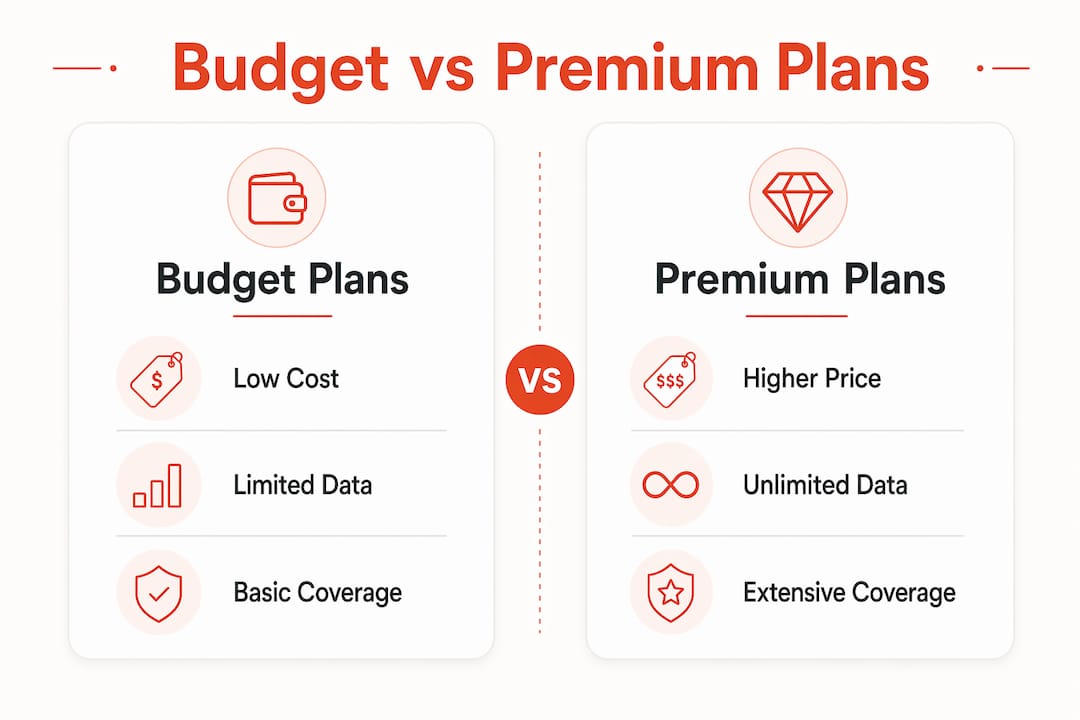
The provider market has grown quickly, and the differences between them matter. Here is an honest look at the main options for affordable travel data plans.
Airalo is the most widely recognised eSIM marketplace, covering over 200 countries. Plans start from around $4.50 USD for small regional packages. The platform is straightforward and the app makes managing multiple plans easy. The trade-off is that customer support can be slow during peak periods.
Holafly focuses on unlimited data plans, which appeals to heavy users. However, speed throttling after a daily threshold means “unlimited” does not always mean fast. For light to moderate users, a capped plan with full speed is often a better choice.
eSIM-X is a strong option for travellers who want transparent pricing and detailed plan breakdowns. Their buyer’s guide approach helps you understand exactly what you are paying for, which aligns well with a budget-first mindset.
Wise offers eSIM plans as part of its travel finance ecosystem, which is convenient if you already use the Wise card. Activation is quick and the pricing is competitive for popular destinations.
Key things to compare across providers:
- Data allowance and cost per GB
- Whether hotspot tethering is included
- Network partner in your destination country
- Support channels (live chat vs email only)
- Whether top-ups or extensions are available mid-trip
Multi-country eSIM bundles are worth considering if you are crossing borders. Buying a Southeast Asia regional plan, for example, costs less than purchasing three separate country plans. Esim4u offers a Southeast Asia 7-country eSIM and a China, Japan, South Korea bundle that cover popular multi-destination routes at a single price.
Common mistakes budget travellers make with eSIM plans
Most connectivity problems and wasted costs come down to a handful of avoidable errors. Here are the ones that come up most often.
-
Overbuying data. Buying 20 GB for a five-day trip is a common overspend. Realistic data estimates prevent this. If your hotel and most restaurants have Wi-Fi, 3 to 5 GB for a week is usually enough for maps, messaging, and light browsing.
-
Choosing the cheapest plan without checking the network. A $2 plan that runs on a weak local network will frustrate you every time you need directions. Always check which carrier the eSIM uses in your destination.
-
Activating at the airport instead of at home. Airport Wi-Fi is unreliable and congested. Installing your eSIM profile at home on a stable connection avoids activation failures when you most need connectivity.
-
Leaving data roaming on for the home SIM. This is the single biggest cause of surprise charges. Turn roaming off on your home line the moment you install the travel eSIM.
-
Misreading the validity start date. Some plans start counting from purchase, not first use. Read the terms carefully or you may land with only a few days of validity remaining.
-
Ignoring hotspot restrictions. If you plan to work from a laptop or share data with a travel companion, confirm the plan allows tethering. Many budget plans block this feature.
Always read the fine print on validity and speed caps before purchasing. The plan that looks cheapest at checkout can cost you more in frustration and wasted data than a slightly pricier option with clear terms.
How to maximise value from your international eSIM plan
Getting the most from a low-cost travel eSIM is about smart habits, not just picking the right plan.
- Install early, activate late. Download your eSIM profile up to 30 days before departure. The data clock does not start until you connect to a local network abroad, so there is no cost to installing early.
- Match your plan to your actual usage. Think about how much time you will spend on Wi-Fi each day. A traveller staying in hotels with reliable Wi-Fi needs far less mobile data than someone on a road trip through rural areas.
- Add buffer days, not buffer gigabytes. If your trip is seven days, buy a 10-day plan rather than doubling the data. Validity buffer is cheaper than data buffer.
- Use a dual-SIM setup correctly. Route all data through the travel eSIM and keep your home SIM for calls and 2FA only. This setup, supported natively on iPhone, gives you the best of both worlds without paying for two data plans.
- Monitor your usage daily. Most phones show per-line data usage in settings. Check it each morning so you are never caught off guard near the end of your trip.
- Choose plans with top-up options. If you run low, a provider that lets you top up without buying a new plan saves time and often money.
Pro Tip: For multi-destination trips, a global 120-country eSIM often works out cheaper than buying individual country plans, especially if you are moving quickly between destinations.
Key takeaways
A budget travel eSIM data plan saves money and removes hassle when you choose based on cost per GB, coverage quality, and realistic data needs rather than the lowest headline price.
| Point | Details |
|---|---|
| Cost per GB is the key metric | Divide total plan price by data allowance to find true value before buying. |
| Install early on home Wi-Fi | Download your eSIM profile before travel to avoid activation issues at the airport. |
| Disable home SIM roaming | Turn data roaming off on your home line to prevent unexpected carrier charges abroad. |
| Match data to realistic use | Estimate daily usage honestly; most travellers with hotel Wi-Fi need 3 to 5 GB per week. |
| Multi-country plans save money | Regional bundles cost less than buying separate plans for each destination country. |
My honest take on budget travel eSIMs
I have activated eSIMs in over a dozen countries, and the single lesson that took me longest to learn was this: stop optimising for the lowest price and start optimising for the lowest stress.
The first time I bought the cheapest plan I could find for a trip to Japan, it ran on a secondary network with patchy coverage outside Tokyo. I saved about $8 and spent two days unable to load Google Maps reliably. The next trip, I paid a few dollars more for a plan confirmed to run on NTT Docomo. No issues at all.
My preferred approach now is to check the network partner first, calculate cost per GB second, and only then look at the total price. Airalo and eSIM-X both make network information visible before purchase, which I appreciate. For Asia-Pacific trips specifically, Esim4u’s regional bundles have been my go-to because the coverage is clearly documented and the activation process is genuinely straightforward.
The dual-SIM setup is non-negotiable for me. Keeping my Australian number active for banking 2FA while running data through a local eSIM has saved me from being locked out of accounts more than once. If you have not set this up yet, do it before your next trip.
The technology is mature enough in 2026 that there is no good reason to pay roaming rates or queue at an airport SIM kiosk. The only thing standing between most travellers and cheap, reliable data abroad is five minutes of research before they pack.
— Peter
Get connected with Esim4u before your next trip
Esim4u offers prepaid eSIM plans for over 120 countries, with transparent pricing and instant digital activation. Whether you are heading to one destination or crossing multiple borders, there is a plan sized to your trip and your budget. Browse special eSIM offers for current deals on popular destinations, or explore regional bundles like the India eSIM and the global 120-country plan for wider coverage. Every plan activates digitally in minutes, with no physical SIM required. Visit Esim4u to find the right plan for your next adventure.
FAQ
What is a budget travel eSIM data plan?
A budget travel eSIM data plan is a prepaid digital SIM profile you download to your phone to access local mobile data abroad at a lower cost than standard carrier roaming. It activates via QR code or app and requires no physical SIM card.
How do I use an eSIM abroad without extra charges?
Enable data roaming only on your travel eSIM line and turn it off on your home SIM. This routes all mobile data through the cheaper travel plan and prevents your home carrier from billing you for international roaming.
When should I activate my travel eSIM?
Download the eSIM profile at home on Wi-Fi before you travel. Most plans only begin counting your data allowance from the first local network connection abroad, so installing early costs you nothing and avoids airport activation stress.
Are unlimited eSIM plans worth it for budget travellers?
Not always. Many unlimited plans throttle speeds after a daily data cap, sometimes to speeds too slow for maps or video calls. A capped plan with full-speed data often delivers better real-world performance for the same or lower price.
Which eSIM plan is best for visiting multiple countries?
A multi-country or regional bundle is the most cost-efficient option for multi-destination trips. Providers including Airalo and Esim4u offer regional plans covering Southeast Asia, East Asia, and global destinations that cost less than buying separate plans for each country.
Recommended
Related Blogs
Explore the World Without Roaming Worries



100% Money Back Guarantee
If you cancel your trip or experience tech issues that we can’t fix; we’ll refund you 100%.