


How eSIM saves money in Australia: 2026 guide
An eSIM (embedded SIM) is a digital SIM built directly into your device that lets you activate a mobile plan without inserting a physical card. For Australian consumers and travellers, this technology is the most direct way to cut mobile costs. Instead of paying Telstra, Optus, or Vodafone’s international roaming rates, you buy a prepaid local or travel data plan at a fraction of the price. Providers like Airalo offer plans starting at around US$3.79 for 1GB, which is dramatically cheaper than paying $10 per day for a roaming pass. Understanding how eSIM saves money in Australia starts with knowing exactly where the savings come from.
How eSIM saves money in Australia vs roaming
Traditional international roaming is expensive by design. Your home carrier charges you a daily or per-megabyte rate to use their partner networks overseas, and those rates reflect destination-specific pricing agreements and pay-as-you-go markups. The Optus Daily Roaming pass costs $5 per day in Zone 1 countries, while Telstra’s International Day Pass runs $5 per day in Oceania and $10 per day in most other countries. Those rates sound manageable until you realise they come with data caps of just 2GB per day, and once you exceed that, pay-as-you-go rates kick in.
Here is what a two-week trip to Europe looks like under each model:
| Plan type | Daily cost | 14-day total | Data included |
|---|---|---|---|
| Telstra Day Pass (Europe) | $10/day | $140 | 2GB/day |
| Optus Daily Roaming (Zone 2) | $10/day | $140 | Limited |
| Prepaid travel eSIM | ~$1.50/day | ~$21 | 10GB+ |
The difference is stark. Travel eSIMs save 70% to 95% compared to carrier roaming for trips longer than a single day. That means a two-week trip to Europe could cost you $21 instead of $140 for mobile data alone. Multi-country trips yield even larger savings because a single regional eSIM plan covers multiple destinations without any additional daily charges.
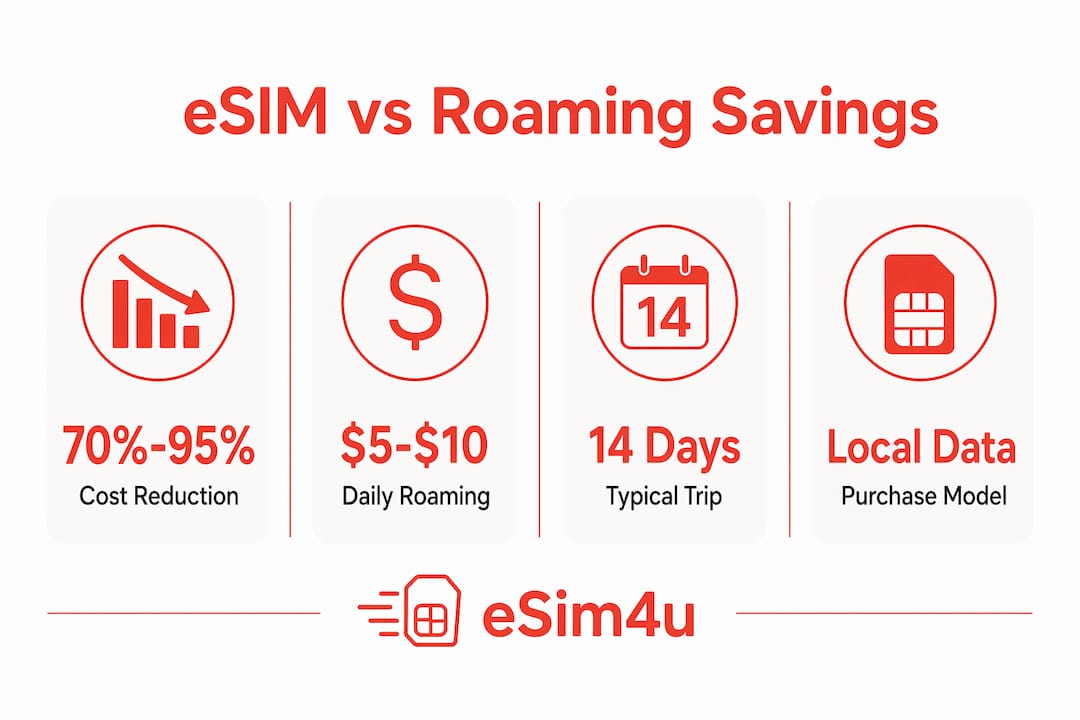
The reason eSIMs are cheaper is structural. When you buy a prepaid travel eSIM, you are purchasing data at local wholesale rates rather than paying your home carrier’s retail roaming markup. Roaming costs are inflated by destination-specific pricing agreements between carriers. An eSIM bypasses that entirely.
How to set up your eSIM to avoid unexpected charges
Getting the savings right depends on correct setup. The most common and costly mistake is “double routing,” where your phone sends data through your home physical SIM while roaming, racking up charges you never intended. Incorrect eSIM setup causes this exact problem when home SIM roaming data is left switched on.
Follow these steps before you travel:
- Purchase your eSIM plan before departure and install it on your device. Most plans activate on first connection to the local network, so do not connect it early or you may shorten your effective usage window.
- Set the eSIM as your default data line in your phone’s mobile data settings.
- Turn off data roaming on your physical home SIM. Go to Settings, select your home SIM, and disable roaming entirely.
- Enable data roaming on the eSIM line only. This tells your phone to use the eSIM for all overseas data.
- Set up spend management alerts through your home carrier’s app before you leave.
Pro Tip: Some eSIM plans only begin their validity period on first connection to the local network. Activate your eSIM only when you land to get the full duration of your plan.
The ACCC notes that providers have a 48-hour window to notify customers after 100% data usage. That means excess charges can accumulate for up to two days before you receive any alert. Actively monitoring your data use through your carrier app, rather than waiting for notifications, is the only reliable way to stay in control.
eSIM vs physical SIM: when does each option win?
The right choice depends on your trip length, destination, and how much you value convenience versus cost per gigabyte.
eSIM is the better choice when:
- You are travelling for under two weeks, especially across multiple countries
- You want instant connectivity the moment you land without queuing at an airport kiosk
- You are visiting major cities in Australia, Europe, Asia, or the Americas where eSIM coverage is strong
- You want to keep your Australian number active for calls and SMS while using cheap data on the eSIM
Physical SIM is the better choice when:
- You are staying in Australia for more than two weeks, particularly in regional or outback areas
- You need the best possible rural coverage, which Telstra provides across 99.5% of the population including remote regions, at a premium of roughly 20 to 30% above competitors
- You want a long-term local plan with a local number
The smartest approach for many Australian travellers is combining both. Use an eSIM for instant arrival connectivity and switch to a local prepaid SIM from Telstra or Optus for stays longer than two weeks. You get the convenience of being connected the moment you land, plus the cost efficiency and coverage depth of a local plan for the long haul.
| Scenario | Best option | Why |
|---|---|---|
| Short trip overseas (under 2 weeks) | Travel eSIM | 70–95% cheaper than roaming passes |
| Multi-country trip | Regional eSIM | Single plan, no daily charges |
| Long stay in regional Australia | Telstra prepaid SIM | Best rural coverage, better long-term value |
| Arriving in a new country | eSIM | Instant activation, no SIM hunting |
For an in-depth breakdown of eSIM plan types and how to match them to your trip, the eSIM plan types guide from Esim4u covers the key differences clearly.
What other benefits does eSIM offer beyond cost savings?
The eSIM cost savings are the headline, but the practical benefits of eSIM in Australia and abroad go further than the price tag.

Instant activation. You can purchase and install an eSIM plan from your phone before you even board the plane. The moment you land, your device connects automatically. No airport SIM kiosks, no waiting, no fumbling with a tiny card and a paperclip.
Easy plan switching. Changing plans or countries no longer requires a physical card swap. You manage everything from your phone’s settings. For frequent travellers moving between Australia, Southeast Asia, and Europe, this alone saves significant time and hassle.
Dual SIM capability. Most modern iPhones and Android devices support eSIM alongside a physical SIM. You keep your Australian number active for calls and SMS while the eSIM handles data. You never miss a call from home while using cheap local data abroad.
Device security. Because an eSIM cannot be physically removed, it is harder for thieves to strip your device of its SIM and use it on another network. This is a small but genuine security advantage.
Pro Tip: Before your trip, check that your device is eSIM compatible and carrier-unlocked. Locked devices cannot use eSIM plans from other providers, which would block all the savings entirely.
For iPhone users, the eSIM installation guide from Esim4u walks through setup step by step so you get it right the first time.
Key takeaways
eSIM technology saves Australian travellers money by replacing expensive carrier roaming with prepaid local data plans that cost up to 95% less for trips over one day.
| Point | Details |
|---|---|
| Roaming costs are avoidable | Telstra and Optus daily roaming passes cost $5–$10 per day; eSIM plans can cost as little as $1.50 per day. |
| Savings scale with trip length | Multi-country and longer trips yield the greatest eSIM cost savings compared to roaming. |
| Setup hygiene prevents bill shock | Disable roaming on your home SIM and route all data through the eSIM line to avoid double routing charges. |
| Combine eSIM and physical SIM | Use an eSIM for arrival and short trips; switch to a local prepaid SIM for stays over two weeks in Australia. |
| Monitor data actively | ACCC rules allow a 48-hour notification delay after data is exhausted, so do not rely on alerts alone. |
Save more on your next trip with Esim4u
Esim4u is an online travel eSIM store offering prepaid plans for Australia and destinations worldwide. You can browse, purchase, and activate a plan entirely from your phone before you leave home. Plans are transparent on pricing with no hidden daily fees. For travellers heading to multiple countries, the Southeast Asia 7-country eSIM covers popular destinations in a single plan. For tailored deals, the special plans page lists current offers for both Australian residents and international travellers. Esim4u also provides clear installation guides and support to make sure your setup is correct from day one.
FAQ
Is eSIM cheaper than roaming in Australia?
Yes. Prepaid travel eSIM plans typically cost 70% to 95% less than standard carrier roaming passes from Telstra, Optus, or Vodafone, particularly for trips longer than one day.
How do I avoid accidental charges when using an eSIM?
Disable data roaming on your physical home SIM and set the eSIM as your default data line. This prevents double routing, which is the most common cause of unexpected charges.
Is eSIM worth it for short trips to Asia or Europe?
Yes. A regional eSIM plan for Asia or Europe covers multiple countries in a single purchase and costs a fraction of daily roaming passes, making it cost-effective even for trips as short as three to four days.
Do I need to buy a new SIM card when I arrive in Australia?
Not if your device supports eSIM. You can purchase an Australia eSIM online before you arrive and connect instantly on landing without visiting a store.
Can I keep my Australian number while using a travel eSIM?
Yes. Most modern smartphones support dual SIM, so your Australian physical SIM stays active for calls and SMS while the eSIM handles data on the local network.
Related Blogs
Explore the World Without Roaming Worries



100% Money Back Guarantee
If you cancel your trip or experience tech issues that we can’t fix; we’ll refund you 100%.