


What is a global eSIM plan? Your 2026 travel guide
A global eSIM plan is a digital SIM profile that connects you to mobile networks across multiple countries without swapping a physical SIM card. Unlike a standard SIM, it lives inside your device and activates instantly via a QR code. Providers like Airalo, Worldsim, and Esim4u offer these plans to travellers and digital nomads who need reliable data the moment they land. The real advantage is that a global eSIM lets you keep your home SIM active at the same time, so you never miss a call from home while you are abroad.
What is a global eSIM plan and how does it differ from a regular SIM?
A global eSIM plan is the industry term for a multi-country embedded SIM service that uses a single downloadable profile to authenticate on carrier networks in dozens or hundreds of countries. A physical SIM is a removable chip tied to one carrier. An eSIM is a chip soldered directly into your device, reprogrammable over the air.
The key difference is flexibility. With a physical SIM, you either pay expensive roaming rates with your home carrier or hunt for a local SIM at every destination. With a global eSIM plan, one profile covers your entire trip.

This matters most for multi-country trips. If you are travelling through Southeast Asia, Europe, or South America over several weeks, managing multiple physical SIMs is genuinely inconvenient. A global eSIM plan removes that friction entirely.
How does a global eSIM plan work technically?
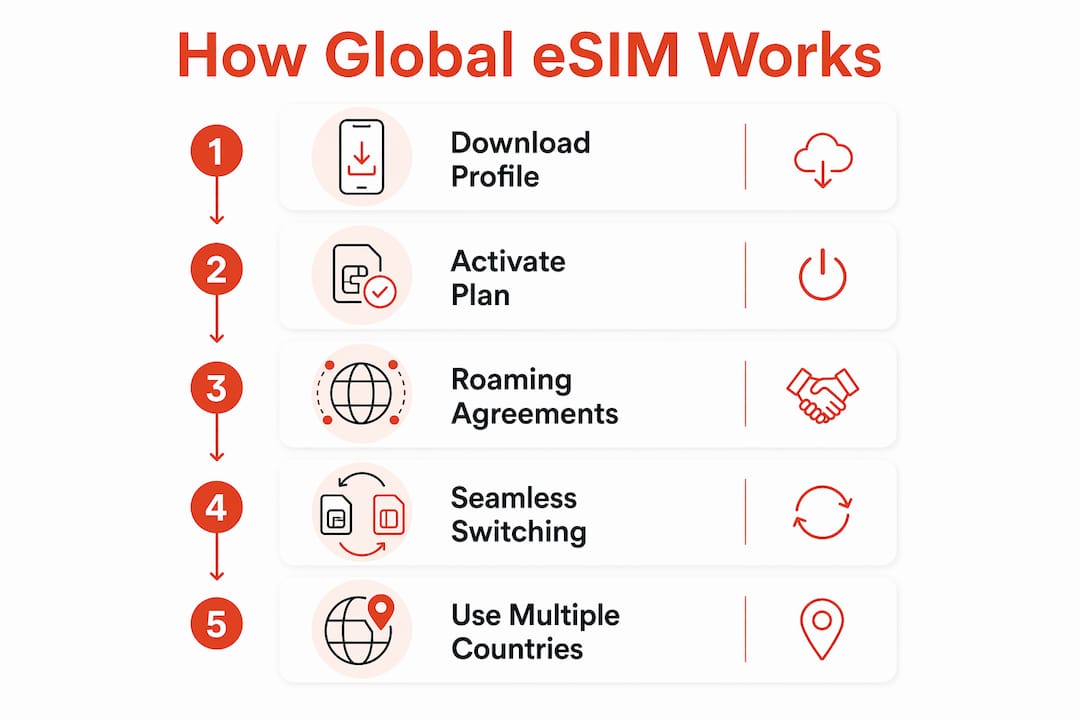
The technology behind a global eSIM plan combines embedded hardware with a software layer governed by GSMA standards. Here is how the process works from purchase to connection:
- Purchase your plan. You buy a global eSIM plan online from a provider like Esim4u before or during your trip.
- Receive your QR code. The provider sends a QR code to your email or app. This code contains your encrypted eSIM profile.
- Scan and install. You scan the QR code in your device settings. Installation takes about 90 seconds, and your device downloads the profile automatically.
- Automatic network selection. Your device references a Preferred Network List (PNL) embedded in the profile. This list tells your phone which local carriers to prioritise in each country.
- Connect and go. When you cross a border, your device authenticates on the next preferred carrier without you doing anything.
The real intelligence sits in the roaming agreements, not just the device. GSMA-governed roaming agreements between your eSIM provider and local carriers specify billing, data rates, quality of service, and technical parameters. This is what allows a single digital profile to authenticate on hundreds of carriers worldwide. The technology in your phone is the delivery mechanism; the agreements are what make global coverage possible.
Pro Tip: Install your eSIM profile before you leave home while you are on Wi-Fi. You can activate it later, but downloading the profile on a stable connection avoids any airport connectivity issues.
Network transitions at borders are designed to be invisible. You will not see a loading screen or receive a prompt. Your device simply connects to the next carrier on the PNL, typically within seconds of crossing into a new coverage zone.
What are the main global eSIM options available to travellers?
Global eSIM options fall into three broad categories: specialist travel eSIM providers, traditional carrier add-ons, and regional plans. Each suits a different type of traveller.
| Provider type | Coverage | Approximate cost | Best for |
|---|---|---|---|
| Worldsim | 195 countries, UK number included | $60 to $80 for two weeks | Frequent travellers needing a consistent number |
| Esim4u Global plan | 120+ countries | Varies by data package | Multi-country trips with flexible data needs |
| Traditional carriers (e.g. AT&T) | Home network roaming | $10 per day | Short trips where keeping your number matters most |
| Regional eSIM plans | 12 to 30 countries per region | Lower cost than global plans | Single-region travel like Europe or Asia |
A few things stand out from this comparison. Traditional carrier add-ons like AT&T’s daily roaming charge can cost over $140 for a two-week trip. That is a significant premium for the convenience of keeping your existing number. Specialist providers like Worldsim and Esim4u offer far better value for the same coverage period.
When choosing between global eSIM options, consider these factors:
- Country count. Does the plan cover every destination on your itinerary, including transit countries?
- Data volume. Pay-as-you-go suits light users; monthly and daily plan types suit heavy data users or longer trips.
- Calls and texts. Most global eSIM plans are data-only. If you need voice calls, check whether the plan includes them or whether you will use VoIP apps like WhatsApp.
- Top-up options. Can you add more data mid-trip without buying a new plan?
Regional plans from Esim4u, such as the Europe and UK plan covering 30 countries or the Asia plan for 12 countries, offer a cost-effective middle ground if your travel is concentrated in one part of the world.
What are the key benefits and drawbacks of a global eSIM?
The benefits of a global eSIM plan are clearest for travellers visiting more than two countries on a single trip. Here is an honest breakdown.
Benefits:
- No SIM swapping. You never need to find a local SIM shop, queue, or risk losing your physical SIM at the airport.
- Dual SIM capability. Global eSIM plans let you keep your physical SIM active while using the eSIM as a secondary line. Your home number stays reachable.
- Cost control. Pre-purchasing a data package means you know exactly what you are spending before you travel.
- Instant activation. Plans activate in under two minutes with no store visit required.
- Multiple plans on one device. You can activate multiple eSIM profiles and switch between them as needed, which is useful for long-haul digital nomads.
Drawbacks:
- Device compatibility. Not all phones support eSIM. Older Android models and budget handsets often lack eSIM capability.
- Speed variability. Because your eSIM connects to a partner carrier rather than the dominant local network, data speeds can vary by country.
- Data-only by default. Most global eSIM plans do not include a local phone number, so voice calls require a VoIP app.
- Premium pricing for global coverage. A global plan costs more than a local SIM in a single country. If you are staying in one place for a month, a local SIM is almost always cheaper.
Pro Tip: Check your phone’s eSIM compatibility before purchasing. On iPhone, go to Settings > General > About and look for an EID number. On Android, the path varies by manufacturer but is usually under Settings > Connections > SIM Manager.
The honest answer to “is a global eSIM worth it” is: yes, for trips spanning multiple countries, and no, for extended stays in a single destination where a local SIM delivers better value and faster speeds.
How to set up and manage your global eSIM plan while travelling
Setting up a global eSIM plan is straightforward. Follow these steps for a smooth experience:
- Check compatibility. Confirm your device supports eSIM. Both Android and Apple devices support QR code installation, with dedicated setup guides available for each platform.
- Purchase before departure. Buy your plan online and receive your QR code by email. This avoids airport stress and lets you install on a stable Wi-Fi connection.
- Install the profile. On iPhone: Settings > Mobile Data > Add eSIM > Use QR Code. On Android: Settings > Connections > SIM Manager > Add eSIM. Scan the code and confirm the installation.
- Set your data line. In your device settings, assign the eSIM as your primary data line and keep your physical SIM for calls and texts from home.
- Monitor your usage. Check data consumption in your device settings or through your provider’s app. Global eSIM plans support pay-as-you-go, daily, and monthly options, so topping up mid-trip is usually straightforward.
- Troubleshoot at borders. If your connection drops after crossing a border, toggle aeroplane mode on and off. This forces your device to re-scan for available networks and reconnect via the PNL.
Managing multiple plans on one device is possible on most modern smartphones. You can store several eSIM profiles and switch between them in settings. This is particularly useful for digital nomads who buy regional plans for each leg of a long trip rather than one global plan for the whole journey. Understanding the different types of travel eSIM plans helps you decide which structure suits your itinerary best.
Key takeaways
A global eSIM plan is the most practical connectivity solution for multi-country travellers, combining instant activation, dual SIM capability, and GSMA-backed roaming coverage in a single digital profile.
| Point | Details |
|---|---|
| Definition | A global eSIM plan is a downloadable digital SIM profile covering multiple countries from one purchase. |
| How it works | QR code installation takes 90 seconds; the PNL handles automatic network switching at borders. |
| Cost comparison | Specialist providers cost far less than traditional carrier daily roaming fees for trips over one week. |
| Best use case | Multi-country trips benefit most; single-destination stays are often better served by a local SIM. |
| Device check | Confirm eSIM compatibility via EID number on iPhone or SIM Manager on Android before purchasing. |
Get connected with Esim4u before your next trip
Esim4u offers global eSIM plans covering 120+ countries with transparent pricing and instant QR code delivery. You can purchase your plan online, receive your code by email, and be connected within minutes of landing. No queues, no SIM trays, no roaming surprises. For Android users, the Android setup guide walks you through every step. iPhone users can follow the Apple device guide for a quick, hassle-free install. Whether you are a digital nomad covering multiple continents or a traveller on a two-week holiday, Esim4u has a plan sized for your trip.
FAQ
What is a global eSIM plan in simple terms?
A global eSIM plan is a digital SIM profile you download to your phone that gives you mobile data access across multiple countries without swapping physical SIM cards. You activate it by scanning a QR code, and it connects automatically to local carrier networks as you travel.
How does a global eSIM plan work at borders?
Your device uses a Preferred Network List embedded in the eSIM profile to identify and connect to the best available carrier in each country. Network transitions at borders are automatic and typically take seconds, with no action required from you.
Is a global eSIM plan worth it for short trips?
For trips covering two or more countries, a global eSIM plan is almost always better value than traditional carrier roaming. AT&T’s daily roaming charge, for example, can exceed $140 over two weeks, while a specialist global plan covers the same period for significantly less.
Can I use a global eSIM and keep my regular number active?
Yes. Global eSIM plans support dual SIM use, meaning your physical SIM stays active for calls and texts on your home number while the eSIM handles data. This is one of the most practical features for travellers who need to stay reachable on their regular number.
Which devices support global eSIM plans?
Most modern iPhones from the iPhone XS onwards and a wide range of Android devices from manufacturers including Samsung, Google Pixel, and OnePlus support eSIM. Check for an EID number in your device settings to confirm compatibility before purchasing a plan.
Related Blogs
Explore the World Without Roaming Worries



100% Money Back Guarantee
If you cancel your trip or experience tech issues that we can’t fix; we’ll refund you 100%.