


How unused eSIM data works for travellers
Unused eSIM data is permanently forfeited once your plan’s validity period ends or your data allowance runs out. There is no rollover, no refund, and no reactivation. Understanding how unused eSIM data works is the difference between a well-planned trip and a wasted data budget. Providers like Airalo and plans catalogued by Earth SIMs confirm this as standard policy across the travel eSIM industry. Whether you are on a 7, 15, or 30-day plan, the clock runs out and your remaining data disappears with it.
How does unused eSIM data work across plan types?
Not all eSIM plans handle data expiry the same way. The three main plan structures each treat unused data differently, and knowing which you are on changes how you should manage your usage.
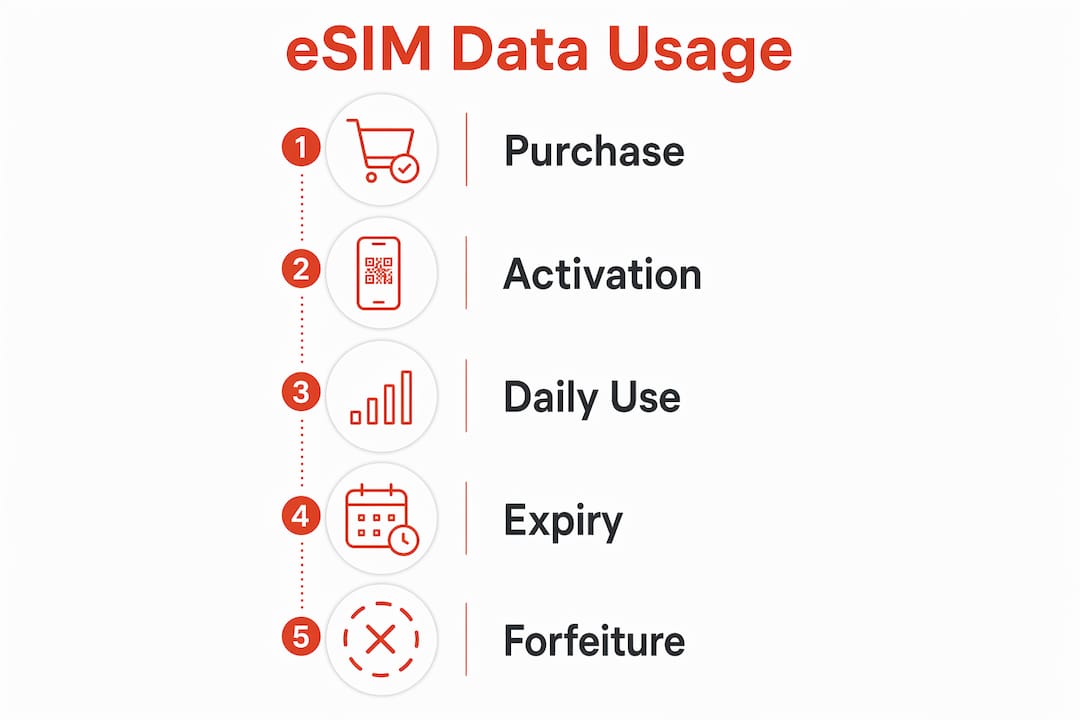
GB-based plans are the most common type. You buy a fixed data allowance, say 5 GB or 10 GB, and you have a set number of days to use it. Standard fixed-duration plans do not allow data to carry over. Unused data is permanently forfeited at midnight on the final day of validity. If you buy 10 GB for 15 days and only use 6 GB, the remaining 4 GB is gone.

Unlimited plans
Unlimited plans assign you a fixed high-speed quota every day (e.g., 1 GB or 2 GB). This structure is highly popular with Asian eSIM providers, but it comes with a strict "use it or lose it" rule.
-
No Data Carryover: Your daily allowance resets completely at midnight.
-
The "Lose It" Example: If you have a 1 GB daily limit and only use 600 MB, the remaining 400 MB expires at midnight. It will not roll over into the next day.
Fair Use Policy (FUP) Example
Daily Limit: For example, you receive 1 GB of high-speed data per day. Once you exceed this 1 GB limit, your speed is reduced to 256 Kbps for the rest of the day. There is no usage cap on the reduced speed, and your high-speed 1 GB allotment resets the following day.
Truly Unlimited plans work on a different logic entirely. There is no data cap to exhaust. Instead, unlimited plans expire by validity period rather than by data amount. The concept of “unused data” here means unused days, not unused gigabytes. These plans suit travellers whose usage is unpredictable or variable across a trip.
Here is how the three plan types compare:
| Plan Type | Data Cap | Unused Data Outcome | Best For |
|---|---|---|---|
| GB-based fixed | Yes | Lost at plan expiry | Predictable, moderate users |
| Daily unlimited | Yes (per day) | Lost at midnight each day | Consistent daily users |
| Unlimited | No | Unused days lost at expiry | Variable or heavy users |
Pro Tip: If you are on a daily unlimited plan, try to front-load data-heavy tasks like map downloads and video calls early in the day rather than leaving them for the evening when you are likely to hit your limit.
For a deeper look at how these structures compare, the eSIM plan types guide at Esim4u covers each option in plain terms.
Why does unused eSIM data get forfeited?
The forfeiture of unused data is not accidental. It is the result of deliberate technical enforcement combined with a straightforward commercial model.
On the technical side, the mobile network gateway monitors your data consumption and validity window in real time. Once your data cap is reached or your validity period ends, the gateway terminates your connection automatically. The connection is hard-terminated by the gateway, and the eSIM profile is treated as one-time use. You cannot reconnect on the same profile after expiry.
The commercial reasons are equally direct:
- No rollover policy keeps plan pricing simple and predictable for providers.
- No refunds on unused data removes the administrative overhead of partial reimbursements.
- Plan renewal incentive means providers benefit when travellers purchase a new plan rather than extending an existing one.
- One-time profile use prevents misuse of a single plan across multiple trips or devices.
There is a common misconception worth addressing. Many travellers assume an eSIM profile can be reloaded or reactivated after expiry, similar to topping up a prepaid SIM card. Standard eSIM profiles are one-time use. Once expired, the profile must be deleted from your device and a new one purchased and installed. Some providers do allow top-ups before expiry, but this extends your data allowance rather than reactivating a dead profile.
Understanding this architecture helps you make smarter decisions before you travel, not after you have already lost data.
How can you optimise eSIM data usage abroad?
Overbuying data is the primary cause of wasted unused eSIM data among travellers. The fix is straightforward: match your plan to your actual usage habits. Here is how to do that systematically.
-
Estimate your daily data needs before you buy. A typical day of travel data use, including maps, messaging, and light browsing, sits around 300–500 MB. Streaming video or using mobile hotspots can push that to 2 GB or more per day. Be honest about your habits.
-
Choose a plan duration that matches your trip exactly. Selecting plans that match estimated daily use closely is the single most effective way to avoid waste. A 7-day plan for a 5-day trip means two days of paid validity you will never use.
-
Use your device’s built-in data monitoring tools. Both iOS and Android have native data usage trackers under Settings. Check them daily. Set a manual alert at 80% of your allowance so you have time to adjust behaviour or purchase a top-up.
-
Consider top-up options before your plan expires. Some providers allow top-ups without requiring you to delete and reinstall your eSIM profile. This is far more convenient than starting fresh, so check whether your provider offers this before you travel.
-
Switch to Wi-Fi aggressively. Hotels, cafes, and airports in most destinations offer reliable Wi-Fi. Reserve your eSIM data for when you genuinely need mobile connectivity, such as navigation between locations or urgent communications.
Pro Tip: Check whether your plan’s validity countdown starts at purchase or at first network connection. Activation timing is critical for maximising your data duration. If it starts at purchase, activate your eSIM on the day you land, not the day you buy it.
For travellers heading to Southeast Asia, where daily reset plans are especially common, the Southeast Asia eSIM guide at Esim4u explains which plan structures work best in that region.
What happens to your eSIM profile after data expires?
When your eSIM data runs out or your validity period ends, the experience is abrupt. Your device loses mobile data access immediately. There is no warning screen, no grace period, and no partial access. Mobile data connections stop automatically after the data cap or expiry, with no overage charges but also no continued access.
Here is what you can expect after expiry:
- Your eSIM profile remains on the device but is inactive. It will not reconnect to any network for data.
- You cannot access any remaining data. Even if you had 500 MB left when the validity clock ran out, that data is gone.
- The profile must be deleted before you can install a new one from the same provider in most cases.
- A new plan must be purchased to restore connectivity. This means going through the full purchase and installation process again.
Common mistakes travellers make at this point include trying to toggle the eSIM off and on, restarting the device, or contacting their home carrier. None of these actions restore access. The only path forward is a new plan.
One practical workaround: if you know you are running low, purchase your next plan before the current one expires. Many providers let you install a second eSIM profile on your device in advance, ready to activate the moment your current plan ends. This avoids any connectivity gap mid-trip.
Key takeaways
Unused eSIM data is permanently lost at expiry, so matching your plan type and duration to your actual travel usage is the most effective way to avoid waste.
| Point | Details |
|---|---|
| No rollover or refunds | Unused data is permanently forfeited at the end of every plan type, without exception. |
| Plan type shapes expiry behaviour | GB-based plans lose data at validity end; daily reset plans lose unused daily quota at midnight. |
| Gateway termination is automatic | The network hard-terminates your connection at expiry; no grace period or partial access exists. |
| Activation timing matters | Some plans start validity at purchase, not first use, so activate on arrival to maximise your window. |
| Top-ups beat reinstallation | Where available, topping up before expiry is faster and simpler than deleting and reinstalling a profile. |
Plan smarter with Esim4u
Esim4u offers a wide range of travel eSIM plans designed to give you real control over your data usage abroad. Whether you need a fixed GB plan for a short trip or a longer validity option for extended travel, you can browse and compare plans before you buy. The global eSIM plans cover 120+ countries, so you are not locked into a single destination. Activation is instant and the process is fully online. If you want to explore the full range of available options by region and plan type, the Esim4u special sites page is a good starting point. No surprises, no hidden fees, and no wasted data from a plan that does not fit your trip.
FAQ
Does unused eSIM data roll over to the next plan?
No. Unused data is lost and inaccessible once the plan ends. No rollover or refund is available on standard travel eSIM plans.
When does an eSIM validity period start counting down?
It depends on the provider. Some plans start validity at purchase, while others begin the countdown at first network connection. Always check the activation terms before buying.
Can i reactivate an expired eSIM profile?
No. Standard travel eSIM profiles are one-time use. Once expired, you must delete the profile and purchase a new plan to restore connectivity.
What happens if i run out of data before my plan expires?
Your mobile data connection stops automatically with no overage charges. You will need to purchase a top-up or a new plan to continue using data for the remainder of your validity period.
Are daily reset eSIM plans better for avoiding unused data waste?
Not necessarily. Daily reset plans waste unused daily quotas at midnight each day. They suit travellers with consistent daily usage but can result in more total waste if your usage varies significantly day to day.
Related Blogs
Explore the World Without Roaming Worries



100% Money Back Guarantee
If you cancel your trip or experience tech issues that we can’t fix; we’ll refund you 100%.